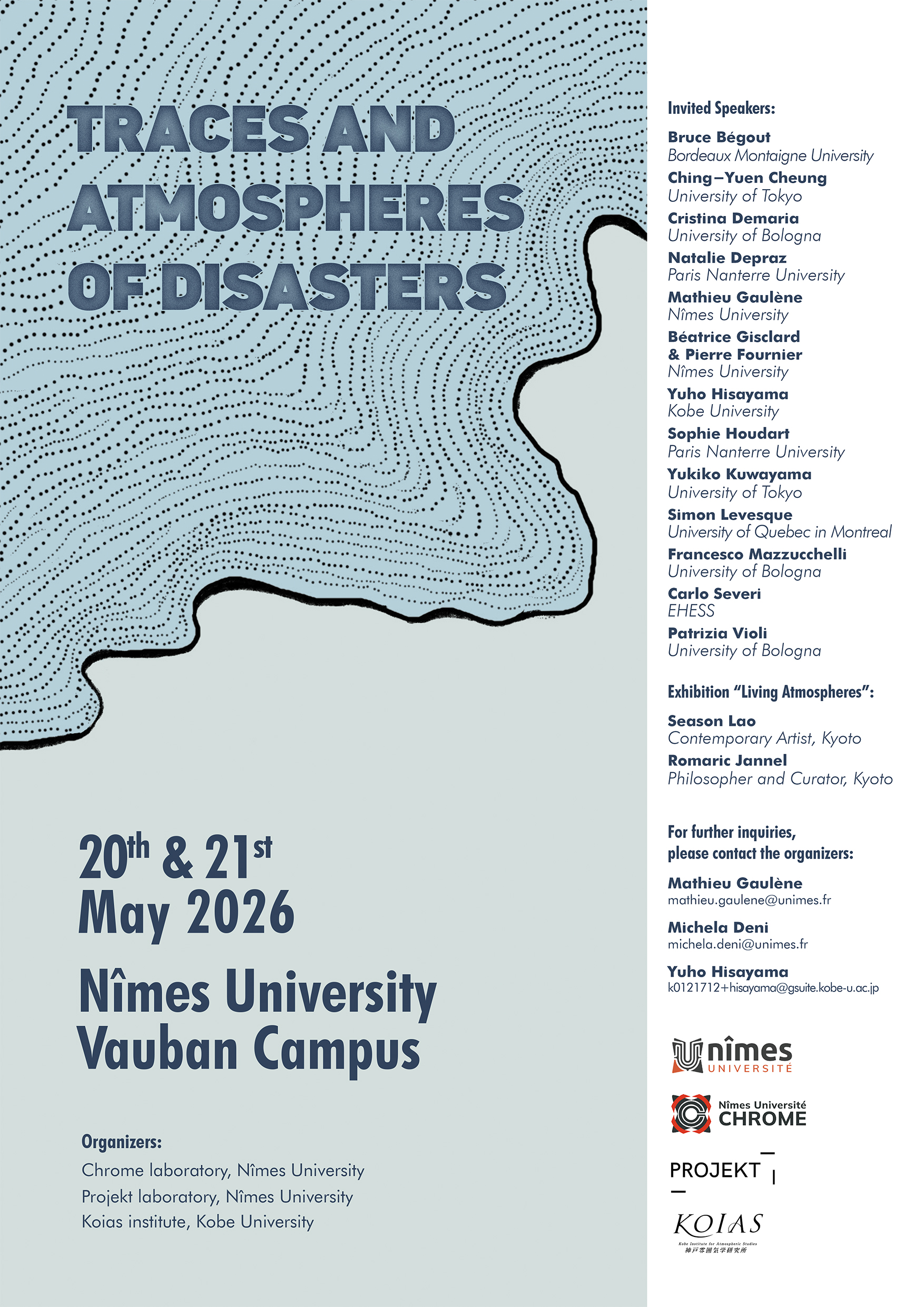
les 20 et 21 mai 2026 à Nîmes Université
[English version below]
Les laboratoires CHROME et PROJEKT (Nîmes Université) et le Kobe Institute for Atmospheric Studies (Kobe University, Japon) ont le plaisir de vous annoncer la tenue prochaine du colloque international Traces and Atmospheres of Disasters
qui se tiendra les 20 et 21 mai 2026 sur le campus Vauban de Nîmes Université.
Afin de prévoir au mieux l’organisation de cet événement, merci de vous inscrire sur ce lien et de préciser si votre participation se fera en présentiel ou en distanciel.
Le lien de visioconférence sera disponible prochainement. Programme
Pour toute information complémentaire, vous pouvez nous contacter aux adresses suivantes : michela.deni@unimes.fr – mathieu.gaulene@unimes.fr
Charte graphique du colloque : Nina SeifritzComment ressent-on une catastrophe et comment en transmettre la mémoire ? Deux approches se complètent : la sémiotique des traces et la nouvelle phénoménologie des atmosphères. Dans la tradition sémiotique issue de Peirce, les traces d’un événement catastrophique peuvent en déclencher le sentiment, et leur absence ou leur manipulation pose la question de la transmission. Parallèlement, la nouvelle phénoménologie s’interroge sur ce qui émane d’une catastrophe au-delà des traces visibles : une atmosphère, une ambiance, une tonalité particulière, diffuse et difficile à situer, entre le sujet et son environnement.L’ambition de ce colloque international Traces and Atmospheres of Disasters est d’articuler ces deux traditions épistémologiques, en dialogue avec les travaux d’anthropologues, pour mieux cerner ce qui se joue sous de mauvais astres.L’événement prévoit deux jours de rencontres sur le site Vauban et une exposition à découvrir dans la chapelle récemment inaugurée sur le site Hoche. Les inscriptions à cet événement sont ouvertes et les participants sont invités à préciser si leur participation se fera en présentiel ou distanciel (le lien de visioconférence sera disponible prochainement).Les deux jours de colloque international se tiendront en anglais.
Charte graphique du colloque : Nina SeifritzComment ressent-on une catastrophe et comment en transmettre la mémoire ? Deux approches se complètent : la sémiotique des traces et la nouvelle phénoménologie des atmosphères. Dans la tradition sémiotique issue de Peirce, les traces d’un événement catastrophique peuvent en déclencher le sentiment, et leur absence ou leur manipulation pose la question de la transmission. Parallèlement, la nouvelle phénoménologie s’interroge sur ce qui émane d’une catastrophe au-delà des traces visibles : une atmosphère, une ambiance, une tonalité particulière, diffuse et difficile à situer, entre le sujet et son environnement.L’ambition de ce colloque international Traces and Atmospheres of Disasters est d’articuler ces deux traditions épistémologiques, en dialogue avec les travaux d’anthropologues, pour mieux cerner ce qui se joue sous de mauvais astres.L’événement prévoit deux jours de rencontres sur le site Vauban et une exposition à découvrir dans la chapelle récemment inaugurée sur le site Hoche. Les inscriptions à cet événement sont ouvertes et les participants sont invités à préciser si leur participation se fera en présentiel ou distanciel (le lien de visioconférence sera disponible prochainement).Les deux jours de colloque international se tiendront en anglais.
CHROME and PROJEKT research labs of Nîmes University and the Kobe Institute for Atmospheric Studies (Kobe University, Japan) have the great pleasure of announcing the organisation on the international symposium Traces andAtmospheres of Disasters which will take place on May 20 and 21 of 2026, on the Vauban site of Nîmes University.
In order to receive you in the best conditions, we thank you in advance for your registration through this link and for precising if you will be attending physically or online.
The link for online participants will be communicated later. Program
For any further inquiries, please contact us at the following mailing adresses : michela.deni@unimes.fr – mathieu.gaulene@unimes.fr
Graphic charter : Nina Seifritz What is it like to feel a disaster, and how can the memory of those events be conveyed ? This is a common object of investigation for two different epistemological traditions: the semiotics of traces and the new phenomenology of atmospheres. In keeping with Peirce’s semiotic tradition, traces of a disastrous event can trigger the feeling and memory of it. It also raises the question nowadays of how memory might be transmitted when traces of the event are absent or have been manipulated.
A second philosophical tradition emerges to comprehend the atmosphere that emanates from a disaster, with similar questions regarding the possibility of crafting or manipulating these atmospheres. Establishing how an atmosphere was created faces the same difficulties as determining where it originated. At the heart of this aerial or vaporous feeling lies a process situated between the subject and their environment.
The ambition of this symposium is to articulate these two notions, traces and atmospheres, coming from distinct epistemological traditions, in discussion with the works of anthropologists, to improve our general understanding of what is occurring under the ill-fated stars.This event is scheduled for two days of exchanges on campus Vauban and an exhibition presented in the recently inaugurated chapel of campus Hoche.The symposium will be held in english.
Graphic charter : Nina Seifritz What is it like to feel a disaster, and how can the memory of those events be conveyed ? This is a common object of investigation for two different epistemological traditions: the semiotics of traces and the new phenomenology of atmospheres. In keeping with Peirce’s semiotic tradition, traces of a disastrous event can trigger the feeling and memory of it. It also raises the question nowadays of how memory might be transmitted when traces of the event are absent or have been manipulated.
A second philosophical tradition emerges to comprehend the atmosphere that emanates from a disaster, with similar questions regarding the possibility of crafting or manipulating these atmospheres. Establishing how an atmosphere was created faces the same difficulties as determining where it originated. At the heart of this aerial or vaporous feeling lies a process situated between the subject and their environment.
The ambition of this symposium is to articulate these two notions, traces and atmospheres, coming from distinct epistemological traditions, in discussion with the works of anthropologists, to improve our general understanding of what is occurring under the ill-fated stars.This event is scheduled for two days of exchanges on campus Vauban and an exhibition presented in the recently inaugurated chapel of campus Hoche.The symposium will be held in english.
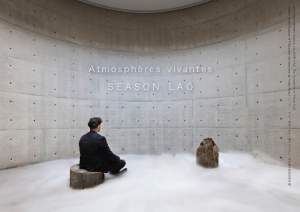
Découvrez d’importantes œuvres de Season Lao :
une réflexion esthétique sur l’atmosphère
la vulnérabilité et la survie installée
dans la chapelle historique de l’université de Nîmes.
—
Discover important artworks from Season Lao:
an esthetical reflexion on atmosphere,
vulnerability and survival exhibited
in the historic chapel of the University of Nîmes.